AI Agents Are Useless Until Your Business Knows What to Delegate
Most companies rush to deploy AI agents and fail. Here's the clarity you need before you start

This is where small and mid-sized businesses need to be careful. The market is pushing AI agents like they are plug-and-play staff. They are not. If your workflow is unclear, an agent does not create clarity. It creates automated ambiguity.
The useful conversation is not, “Can we build an AI agent?” The useful conversation is, “What work are we ready to delegate?”
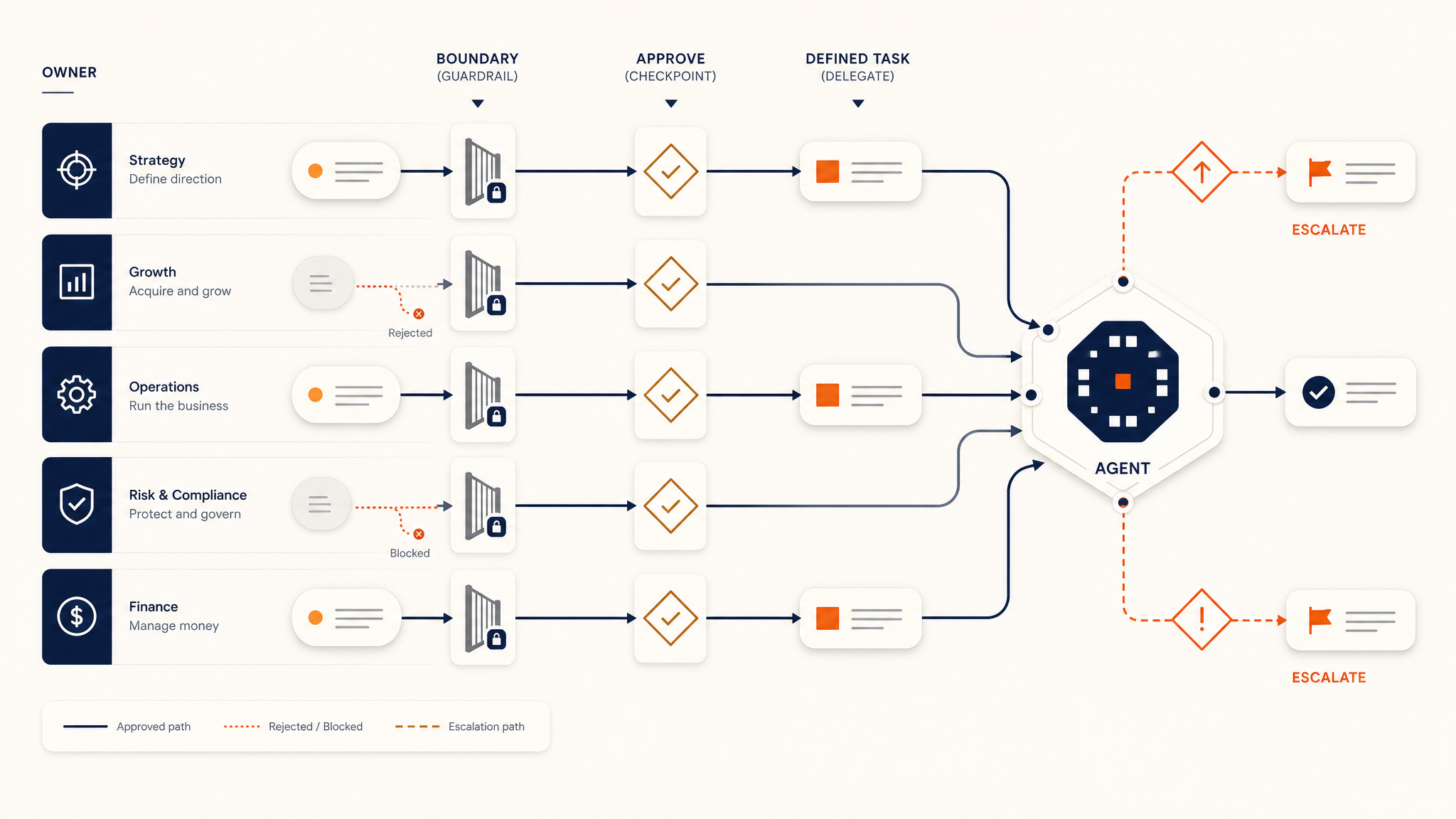
AI agents are not magic employees
Microsoft found that 75% of knowledge workers were already using AI at work in 2024, and 46% of those users had started within the previous six months. Adoption is not the bottleneck anymore. Discipline is.
That same report found 78% of AI users were bringing their own AI tools to work, with the number rising to 80% at small and medium-sized companies. Translation: your team may already be delegating work to AI, but not necessarily through a system you control, govern, or measure.
That is not transformation. That is leakage.
An employee can ask clarifying questions, read the room, recognise politics, and know when something feels off. An AI agent needs that judgement designed into the workflow. It needs task boundaries, source data, approval gates, escalation rules, logging, and measurable outcomes. Without those, it is just a chatbot with more access.
If that sounds less exciting than “hire an AI agent,” good. Boring structure is where the value lives.
Most SMBs do not have an AI problem. They have a delegation problem.
Microsoft’s 2024 Work Trend Index found 68% of people struggle with the pace and volume of work, while 46% feel burned out. The same research shows Microsoft 365 users spend 60% of their time in email, chats, and meetings, and only 40% in creation apps.
That is not a technology shortage. That is an operating model problem.
Most businesses are full of half-owned work. A lead comes in, but nobody knows who qualifies it. A customer asks a pricing question, but the answer depends on tribal knowledge. A service ticket arrives, but routing depends on who happens to see it first. A quote needs preparing, but the assumptions live across email, spreadsheets, and someone’s memory.
Now add an AI agent to that mess.
The agent may move faster, but it will still inherit the same confusion. It will still need to know who owns the next step, which data is trusted, when to stop, what requires approval, and which exceptions are too risky to automate.
This is why bad delegation kills AI projects. Not because the models are weak. Because the business never did the hard work of defining the job.
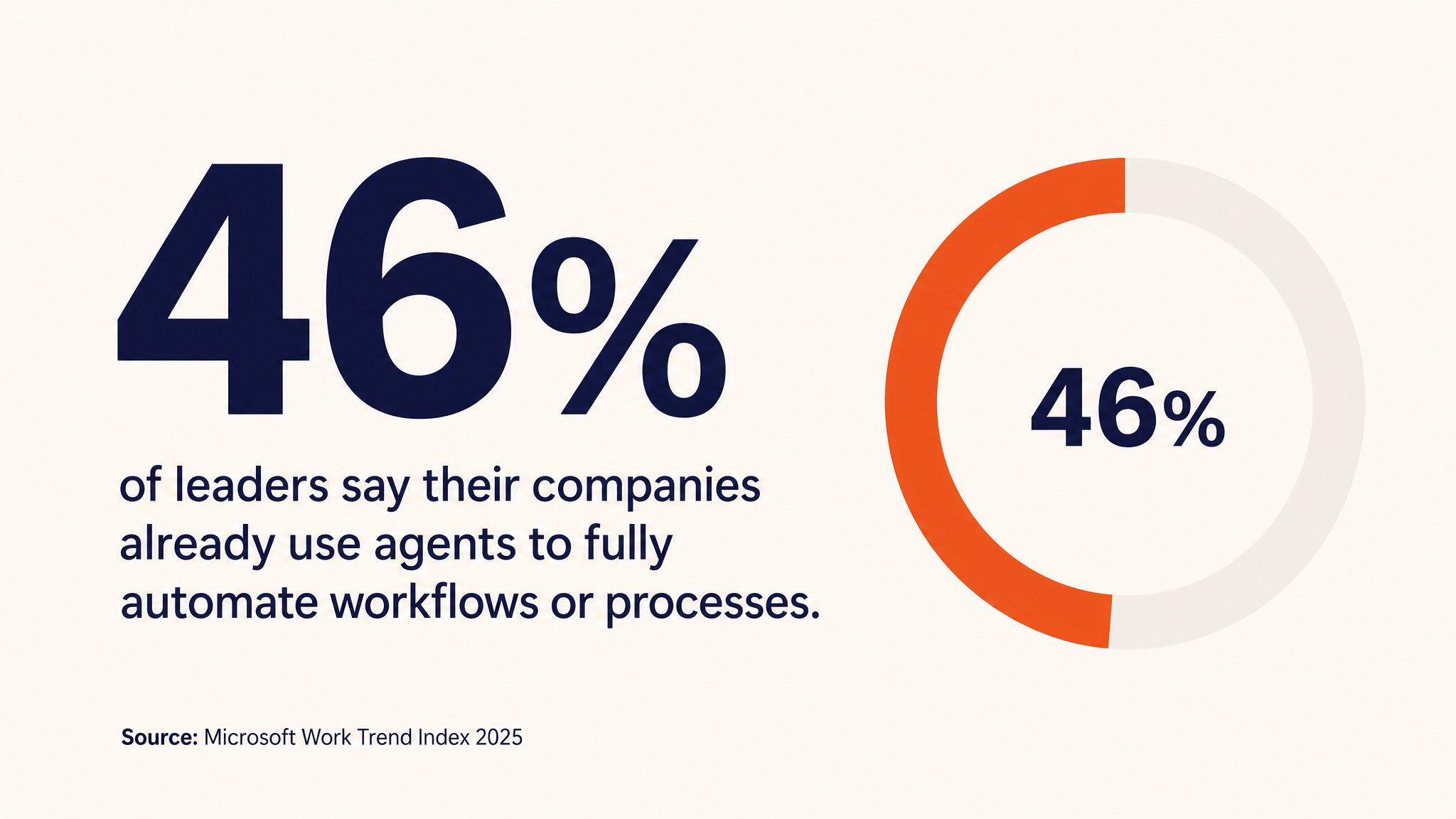
What an AI agent actually needs to work
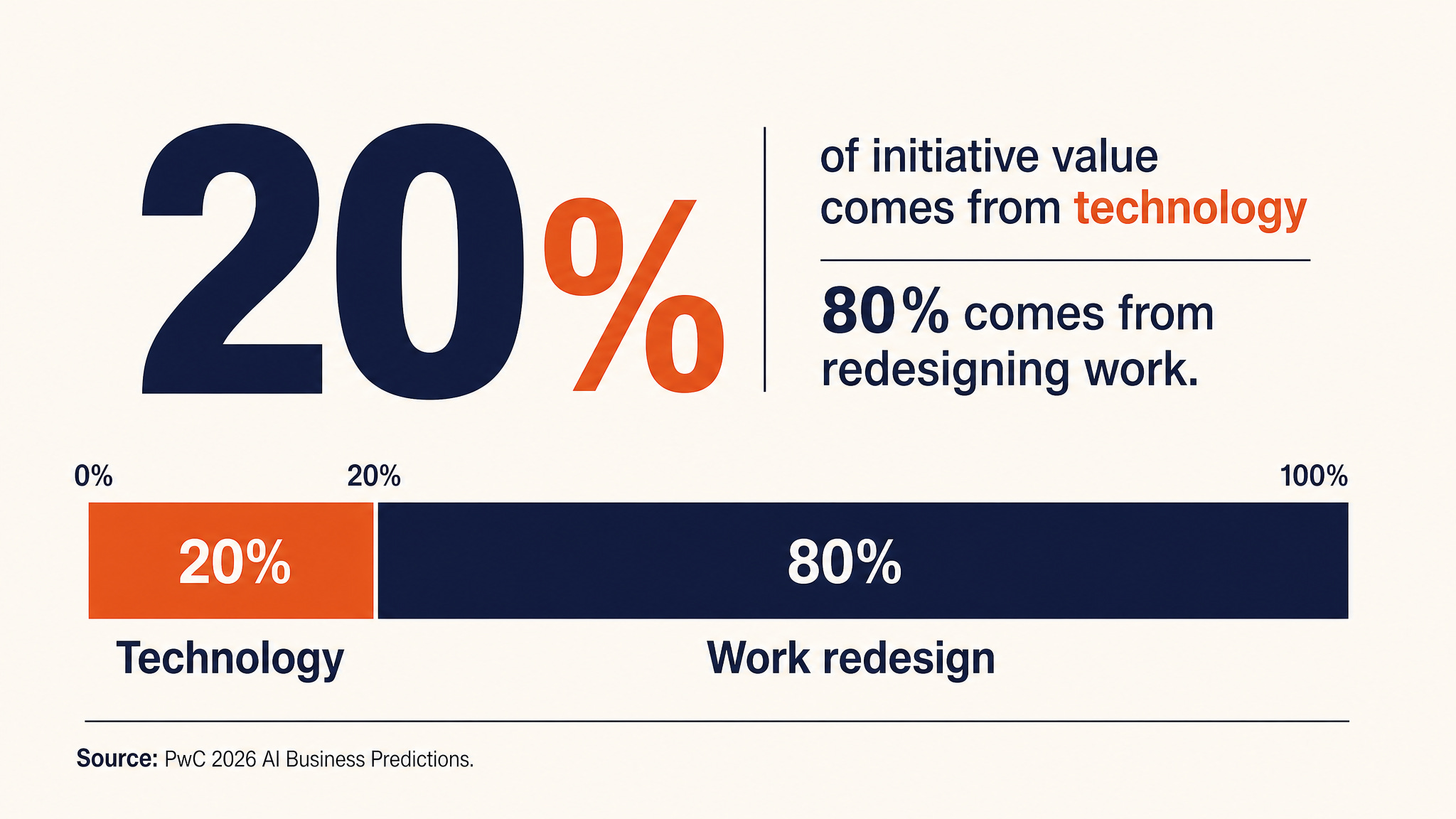
PwC’s 2026 AI Business Predictions makes the point cleanly: technology delivers only about 20% of an initiative’s value. The other 80% comes from redesigning work. That should stop every owner from buying an agent before mapping the workflow.
A useful AI agent needs a narrow job. It should not “help with sales.” It should qualify inbound leads against a specific checklist, summarize missing information, draft the first response, and escalate deals above a defined threshold to a human.
It should not “handle customer service.” It should triage tickets by category, detect urgency, suggest a response from approved knowledge, flag refund requests, and route anything emotional, legal, or high-value to a person.
It should not “support operations.” It should prepare a quote draft from approved inputs, identify missing fields, compare against margin rules, and stop before sending anything externally.
The difference is scope. Scope is what turns AI from a toy into infrastructure.
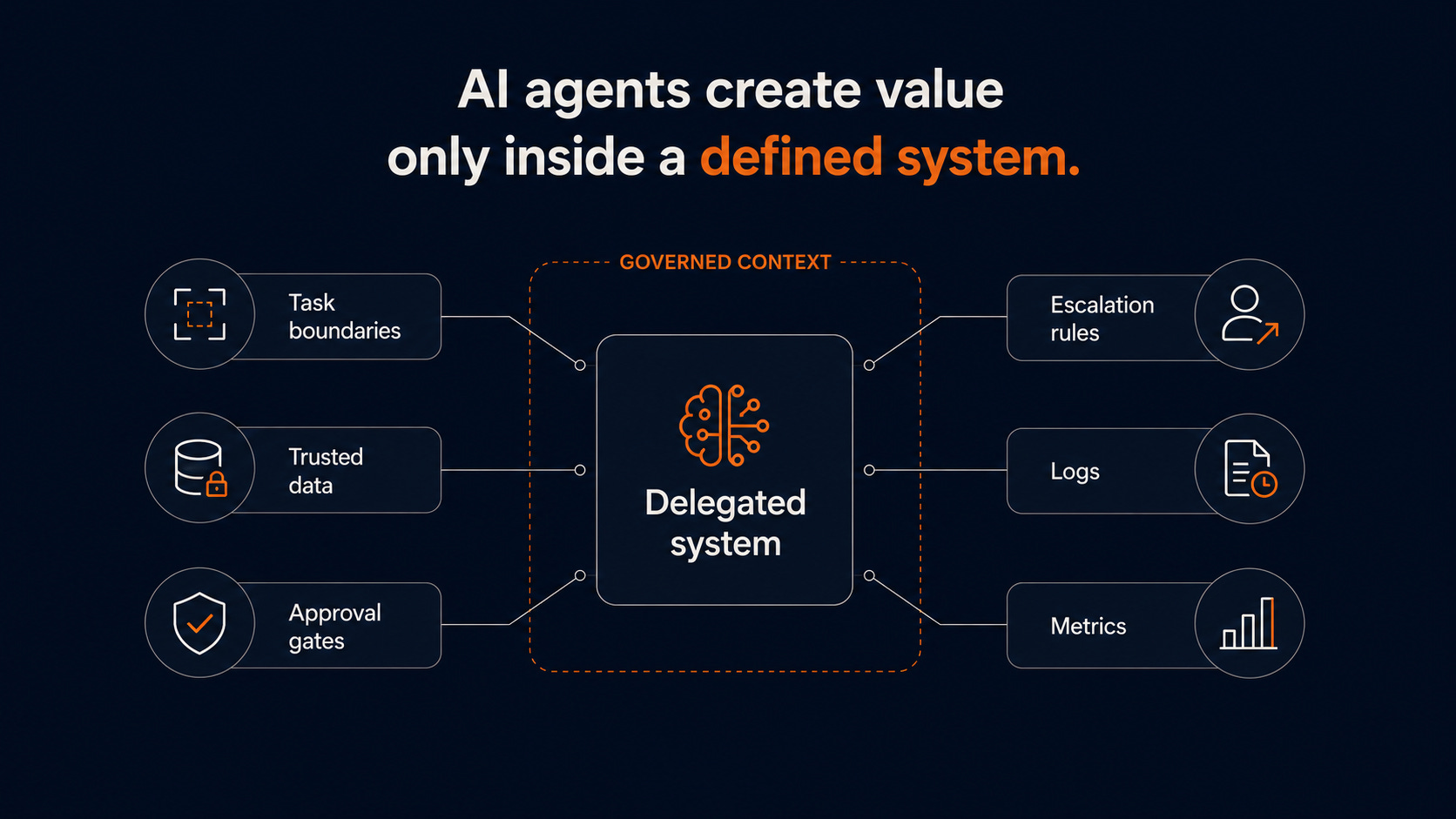
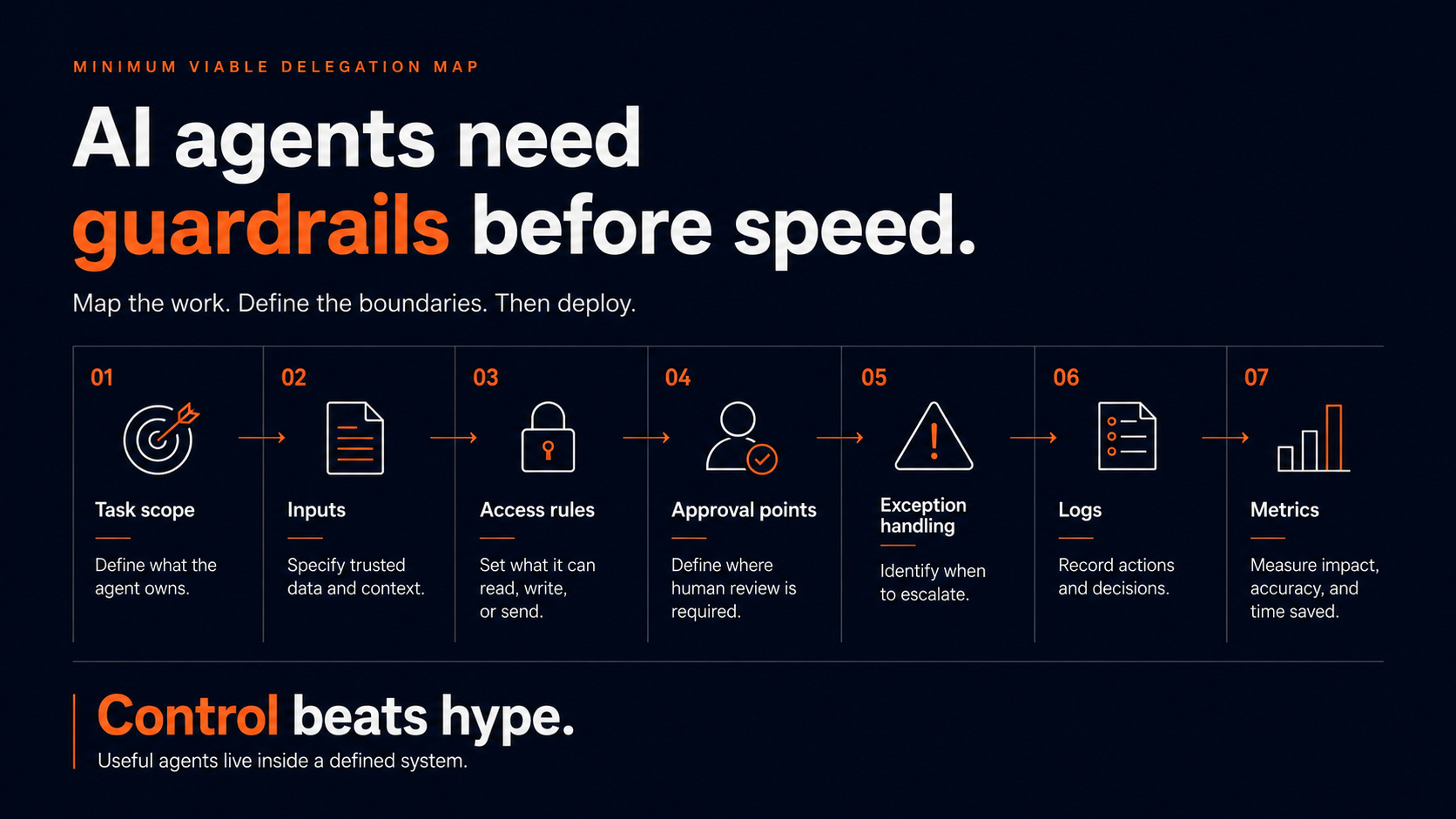
The minimum viable delegation map
Before building an agent, define these seven pieces:
Task scope: what the agent owns, and what it does not own.
Inputs: which data sources, files, forms, messages, or systems it can trust.
Access rules: what the agent can read, write, send, or change.
Approval points: where a human must review before action.
Exception handling: what triggers escalation.
Logs: what gets recorded so the business can audit decisions.
Metrics: how success is measured, such as response time, error reduction, conversion rate, or hours saved.
If you cannot define those, you are not ready for an agent. You are ready for a workflow audit.
Where AI agents can create real SMB leverage
The use cases that work are usually not glamorous. That is the point.
Microsoft reported that 90% of AI users say AI helps them save time, 85% say it helps them focus on their most important work, and 84% say it helps them be more creative. Those benefits are real, but they compound only when the agent removes repeated operational drag.
For SMBs, the strongest first agent use cases are narrow, frequent, and measurable:
Intake triage: classify inbound requests and route them to the right person.
Lead qualification: score inquiries against budget, urgency, fit, and next step.
Internal knowledge search: pull approved answers from policy, SOPs, product notes, and past decisions.
Draft follow-ups: prepare responses that a human can approve or edit.
Quote preparation: gather inputs, flag missing details, and draft pricing assumptions.
Service ticket routing: detect category, urgency, ownership, and escalation path.
The common thread is control. The agent is not being asked to “run the business.” It is being asked to handle a defined slice of work inside a supervised system.
That is how you get leverage without turning your operation into a guessing machine.
The agent hype is skipping the hard part
PwC is blunt about the current market: many agentic deployments have not delivered much value because they were not used in ways that matter, and leaders often could not show a working demo that proved business impact.
That is what happens when companies chase the label instead of the workflow.
The same PwC report says agentic workflows need clearly articulated steps for human initiative, review, and oversight. It also recommends mapping where agents own the work, where people own the work, where they collaborate, and how oversight happens at each step.
That is not a technical detail. That is the strategy.
An AI agent is only as useful as the operating system around it. If the workflow is vague, the data is messy, and nobody owns the outcome, the agent will not save you. It will just make bad process move faster.
Delegate the work that matters, not the work you have not understood
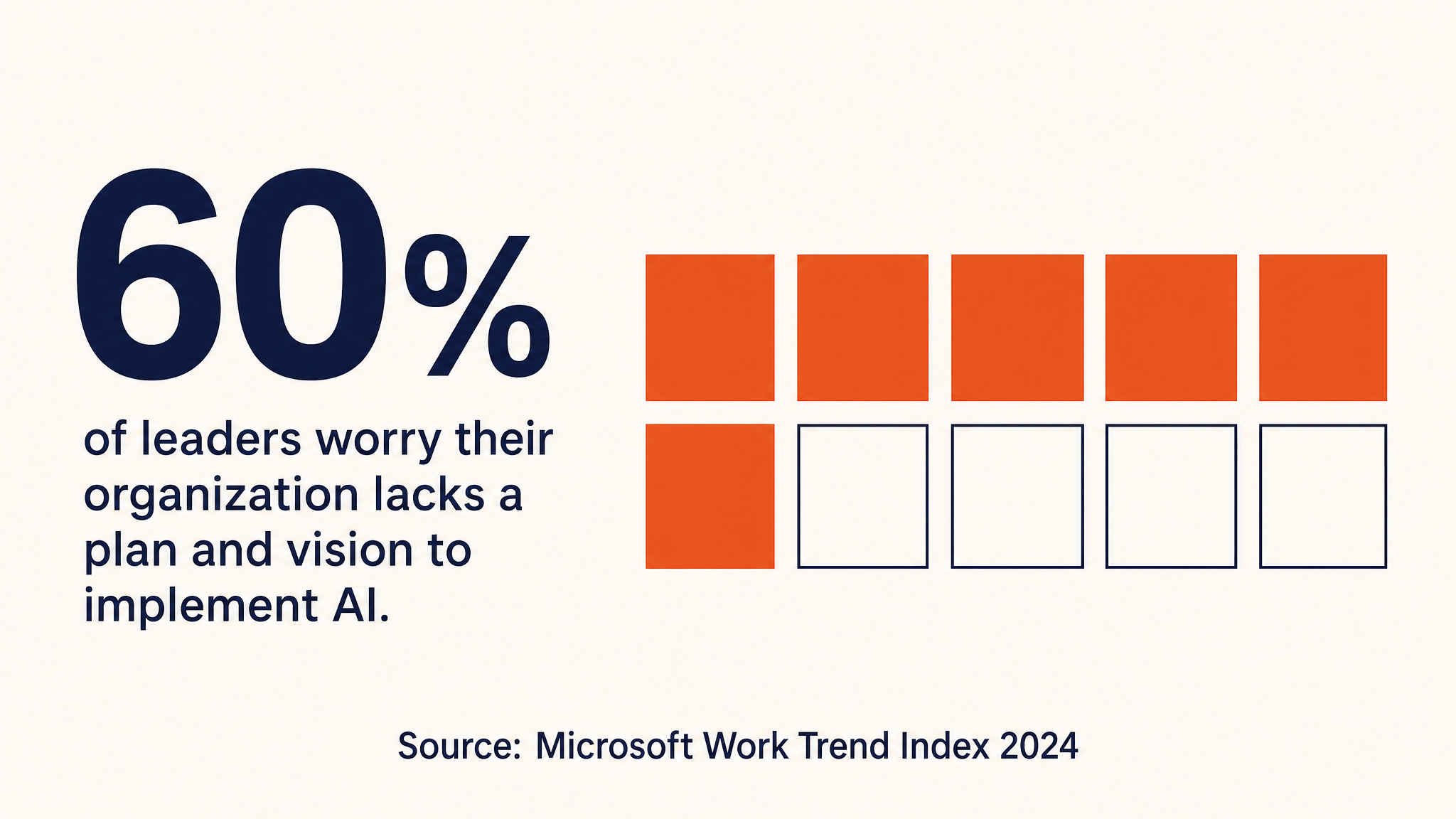
Microsoft found 60% of leaders worry their organization lacks a plan and vision to implement AI. That number should bother every SMB owner, because lack of vision is expensive when tools start acting on behalf of the business.
The answer is not to wait forever. Waiting is its own form of waste. The answer is to start smaller and get sharper.
Pick one workflow that is painful every week. Map it. Define ownership. Identify the repeated steps. Decide what the agent can do safely. Decide what it must never touch. Add approval gates. Measure the result. Then expand.
That is how AI agents become useful. Not by pretending they are magic employees, but by treating them like delegated systems with boundaries, accountability, and a scoreboard.
If your business is looking at AI agents but the workflow still feels messy, do not start with the build. Start with the delegation map. I help SMBs identify the right AI opportunities, design the workflow, and build custom automations that remove real operational drag. If you want to stop wasting time on AI theatre and build something that actually earns its keep, reach out and we can map the first agent properly.